
Equipment comparison · Buyer guide
Suspension vs Strength Equipment: Isokinetic Limits
Choose the training approach that fits the clinic’s intended therapy workflow; do not treat these equipment types as interchangeable.
Updated by RehabIntl:
Quick answer
Choose suspension or conventional strength equipment by the task your clinic needs, not a claim that one delivers universally better outcomes. Our KF-SET suspension system and KF-GST quadriceps chair offer different training formats. Neither listing establishes equivalent isokinetic dynamometer measurement or control capability.
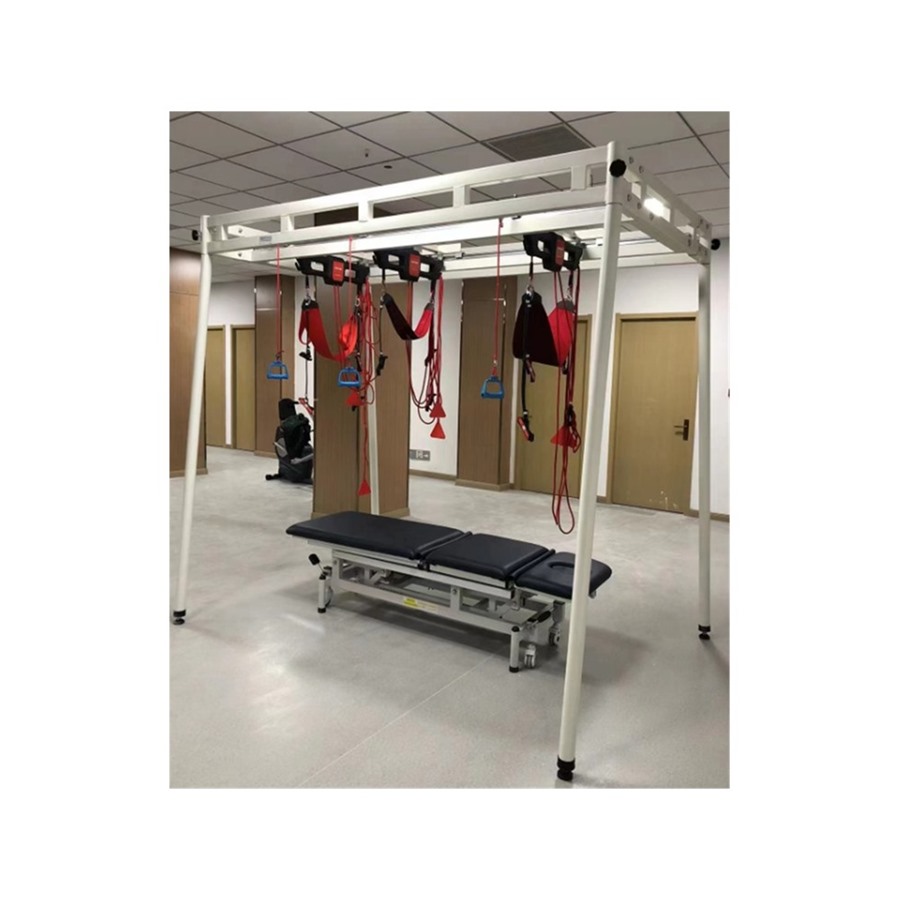
Which equipment fits the task you are buying for?
Our KF-SET floor-frame suspension system with table combines a floor-supported frame with a rehabilitation table for therapist-guided suspension exercise and positioning. Our KF-GST quadriceps training chair is a seated lower-limb training option; its resistance method, support configuration and adjustment range must be confirmed.
These are concrete options from our isokinetic and suspension category and lower-limb range. The category name does not establish that a particular product is an isokinetic assessment device.
| Procurement priority | Option to review | Boundary to record |
|---|---|---|
| A floor-frame suspension station | KF-SET | Confirm frame, table, suspension parts and site conditions; no outcome guarantee |
| A seated knee-extension exercise station | KF-GST | Confirm resistance and positioning; do not assume measurement software |
| Isokinetic testing or controlled assessment | Separate specialist requirement | Neither linked listing establishes equivalence; obtain a specific technical response |
What if you cannot yet fund an isokinetic dynamometer?
Separate the training work you want to start now from the assessment capability you still require. A lower-cost training station may belong in a phased purchase, but it should not be written into a tender as an equivalent substitute unless the required functions are genuinely established.
Make two lists: “functions this phase must provide” and “functions deferred or sourced elsewhere”. If controlled testing data is essential from opening, request a verified specialist solution rather than treating suspension or a resistance chair as a workaround. No comparative price or clinical effectiveness claim is implied here.
How should RehabIntl be briefed?
Send us your planned activity, room layout, selected station and required accessories. Tell us explicitly whether your enquiry concerns supervised exercise or a specified assessment function. Ask for the exact configuration and written exclusions so your clinical team can review the fit without inferring capability from product-category labels.
Compare by intended use
| Option | Consider when | Confirm before buying |
|---|---|---|
| Suspension exercise system | The program uses supported, functional, or task-oriented activity in a flexible therapy space | Suspension points, adjustment range, accessories, clearance, and therapist access |
| Conventional strength equipment | The program requires repeatable resistance exercise with a defined station layout | Resistance steps, user positioning, footprint, transfers, and progression needs |
| Isokinetic system | Specific controlled testing or training functions are required by the program | Exact protocols, attachments, software scope, service plan, and staff training |
| Budget-limited alternative | The clinic needs a phased starting point rather than every advanced function on day one | Which required functions are retained and which cannot be substituted |
Questions to use in an RFQ
- Which patient groups and therapy tasks will this station support?
- Do you need controlled measurement data, or is the primary need supervised exercise?
- What are the room dimensions, ceiling or wall constraints, and transfer routes?
- Which accessories, attachments, training, maintenance, and software are included?
- Which capability is essential at opening and which can be added in a later phase?
Buyer FAQ
Is a suspension system better than strength machines?
Neither is universally better. The right choice depends on the planned therapy activity, patient supervision, desired progression, and available room workflow.
What is a good alternative to an isokinetic dynamometer?
There is no single equivalent substitute. Specify the assessment or training function you need, then compare equipment that supports that workflow while documenting the functions it does not provide.