
Neuro rehabilitation · Equipment comparison
Electric vs Manual Tilt Tables for Neuro Rehab
Choose a tilt-table configuration by safety workflow, adjustment needs, staffing, room constraints, and service capability—not by motorization alone.
Updated by RehabIntl:
Quick answer
For a neuro rehabilitation tilt table, compare the required adjustment, supports, transfers and operating procedures before choosing electric or manual drive. Our listed ZL-3 and ZL-4 options are electric configurations with different positioning features; they do not establish a manual model or one suitable for every patient who cannot stand independently.
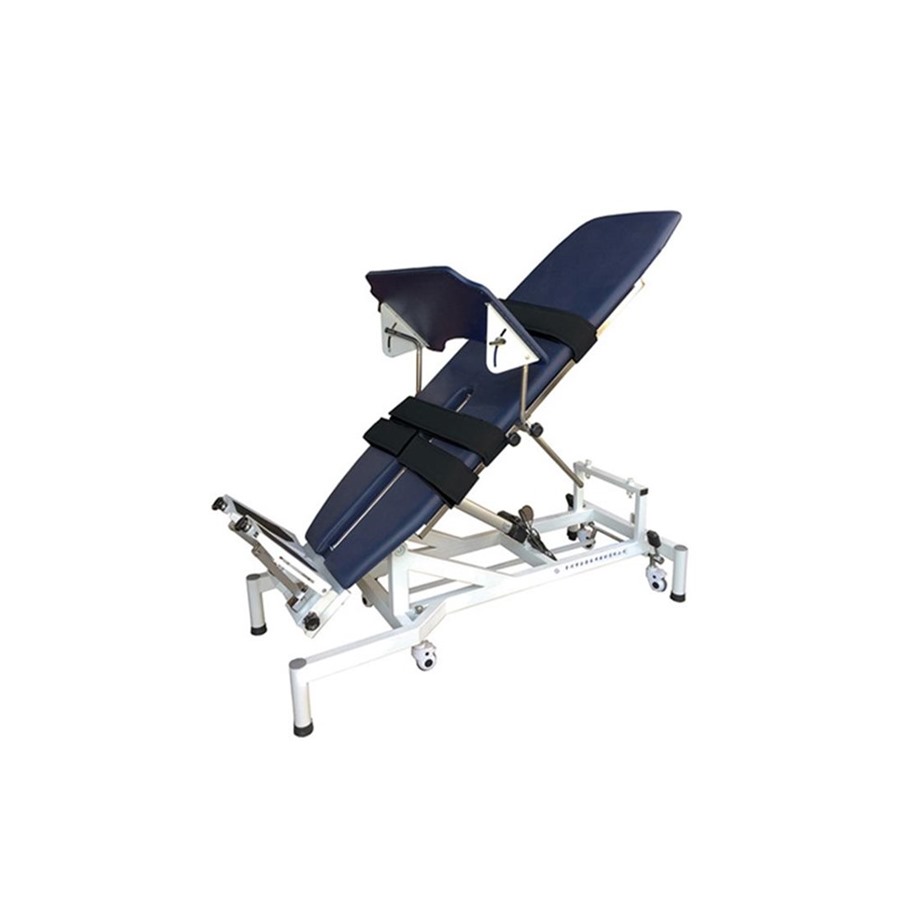
Which electric tilt tables are in our range?
RehabIntl lists two distinct options: KF-XLC-D/ZL-3 electric tilt table with foot positioning and KF-XLC-D/ZL-4 electric standing tilt table with correction board. The ZL-3 listing describes foot inversion and eversion adjustment, while ZL-4 is a correction-board configuration. Confirm exact supports, controls and movement ranges with the quotation rather than assuming both versions have the same features.
| Model | Published configuration | Priority quotation questions |
|---|---|---|
| KF-XLC-D/ZL-3 | Electric tilt table with foot inversion/eversion positioning | Footplate and tilt ranges, straps, controls and electrical requirements |
| KF-XLC-D/ZL-4 | Electric standing tilt table with correction board | Correction-board scope, supports, controls, working limits and electrical version |
Browse our therapy tables and beds for the listed configurations. This guide does not identify a manual tilt table currently offered by RehabIntl; a manual option from another offer needs its own model-specific review.
What should a manual alternative be compared against?
Ask how its adjustment is operated and secured, who performs it, and how the documented transfer and support arrangements fit the facility's workflow. For an electric offer, ask for the control method, power requirements and manufacturer instructions for interruptions or faults. Do not assume any emergency feature merely because the table is powered.
Use the same clinician-defined requirements for both offers. “Cannot stand independently” is not enough information for a purchasing recommendation, and this article does not decide clinical suitability. Your responsible team should define the positioning, supervision and transfer requirements before reviewing a model.
Send a configuration-specific tilt-table enquiry
Tell RehabIntl whether you are considering ZL-3 or ZL-4, the required quantity, destination and your team's essential support and adjustment requirements. Add room and delivery access, voltage and plug requirements, and requested documents. Ask for the included accessory list and operating manual; a generic “electric tilt table price” will not define an equivalent offer.
Compare the workflow, not just the drive type
| Check point | Why it matters |
|---|---|
| Adjustment and controls | Confirm adjustment range, control location, movement behavior, and emergency-stop design. |
| Patient support | Specify straps, supports, foot adjustment, correction board, and required accessories by the planned workflow. |
| Transfer and staffing | Review the transfer route, therapist access, required assistance, and clearance around the table. |
| Facility support | Confirm power, maintenance, parts, warranty boundary, and local service route for the selected model. |
RFQ checklist
- Intended patient pathway and clinician-defined safety requirements
- Required adjustment functions and accessories
- Room dimensions, door widths, lift access, and power availability
- Product dimensions, loading limits, packing data, and manuals
- Warranty, spare parts, installation, training, and service responsibility
Buyer FAQ
Is an electric tilt table always the better choice?
No. “Better” depends on the required workflow, staffing, adjustment needs, room conditions, budget, and ongoing service support.
Can a buyer use the same table for every patient group?
Do not assume so. Clinical suitability and safe use must be defined by qualified practitioners for the specific patient group and protocol.